
Fire Season Ends. Wildfire Preparedness Doesn't.
Scroll DownCanadians are worried about wildfires, but few know how to protect their homes, and fewer still have acted
As another Canadian wildfire season winds down, smoke, evacuation alerts and images of threatened communities begin to fade from the daily news. But the months between fire seasons give homeowners, fire departments and communities something valuable: time to prepare.
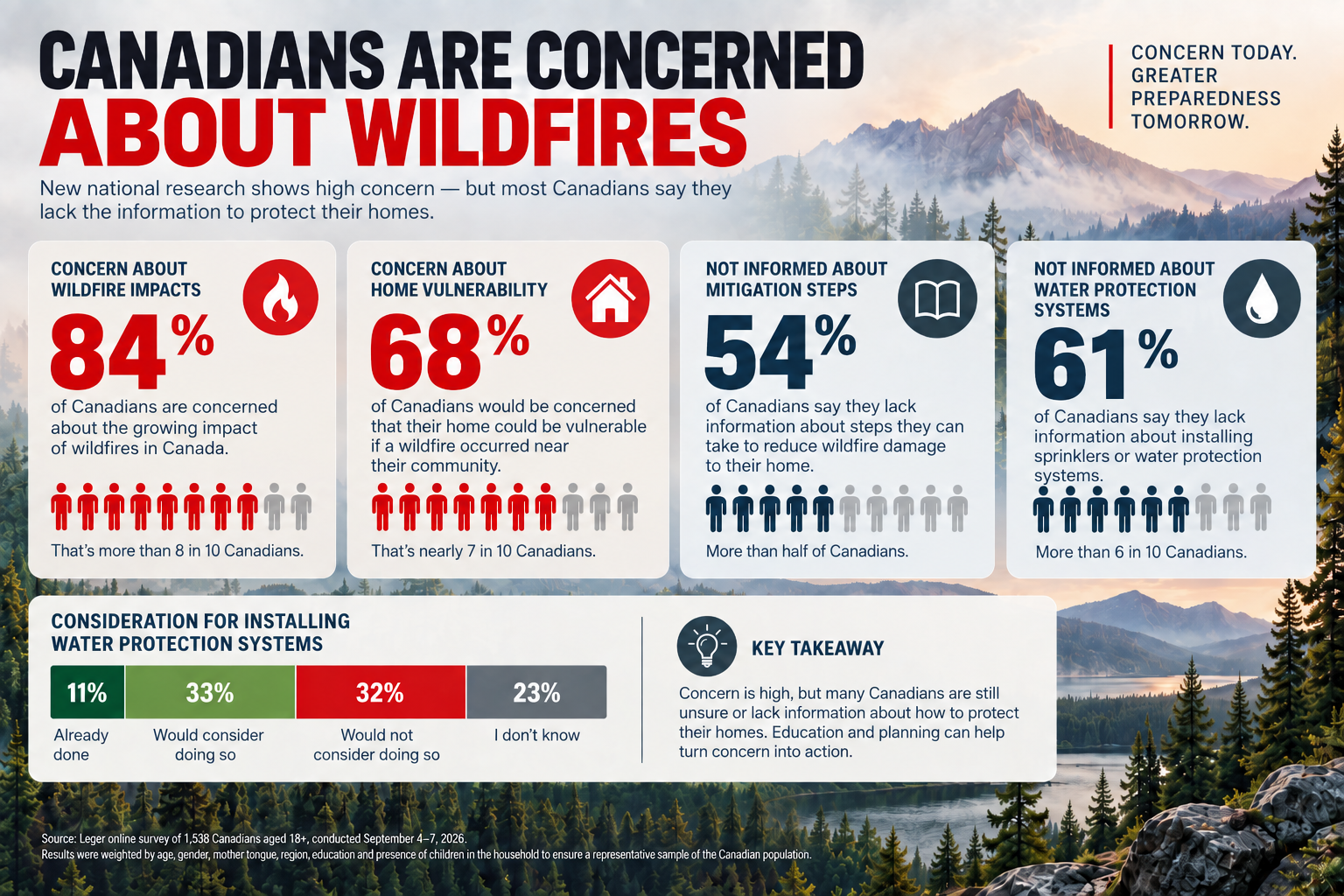
New research shows that Canadians recognize the wildfire threat—and gives fire departments a clearer picture of what the public doesn't know. A September 2026 Leger survey found that 84% of Canadians are concerned about the growing impact of wildfires in Canada, while 68% would be concerned that their home could be vulnerable if a wildfire occurred near their community.
Concern is not the same as knowing what to do about it. More than half of Canadians surveyed (54%) say they lack information about steps they can take to reduce wildfire damage to their homes, while 61% lack information about installing sprinkler or other water-based protection systems. This disconnect between concern and preparedness is clear: only 11% say they have already installed a water protection system.
From concern to preparation
For agencies and departments, the Leger data describes two separate problems.
The first is a knowledge gap. Concern is close to universal, but most Canadians say they lack the information they would need to act on it. Those residents are willing but under-informed about the protection options available to them. The regional spread shows where that effort is landing: British Columbia residents report the highest awareness on nearly every measure Leger tested, and Quebec residents the lowest on every one. The exception: concern that their home would be vulnerable in a wildfire, which was highest among Atlantic Canadians.
The second is a willingness gap, and it is harder. Nearly a third of Canadians (32%) say they would not consider installing a water protection system at all, and resistance is highest among the people with the most to lose: 37% of homeowners say no, compared with 23% of renters. A further 23% say they don't know. Information alone will not move that group.
The two need different responses. Outreach and demonstration work on the first. The second calls for a franker conversation about cost, effort and what a department can realistically promise when hundreds of structures are threatened at once. Fire departments, municipalities and wildfire professionals sit at the centre of both.
Turning awareness into preparation and action before the next season begins
Structure protection should not begin when smoke appears on the horizon. The months outside peak season are when vulnerabilities can be assessed, defensible space established, water sources identified, hose and sprinkler layouts planned and equipment tested under controlled conditions.
FireSmart Canada is the reference point for that work. The national program, delivered provincially, sets out what property owners can do in the area immediately around a structure, and the guidance is free. Water protection systems do not replace those measures; they add a layer on top, and they work best where the fundamentals are already in place.
Many properties also have a firefighting resource already on site: water. Swimming pools, ponds, lakes, irrigation reservoirs and portable tanks can support structure protection without drawing on municipal hydrants, and with the right portable pump and sprinkler layout that water can be moved to the areas around a property most likely to ignite.
What structure protection does
Structure protection sprinklers do not extinguish an advancing wildfire. They wet roofs, walls, decks and surrounding vegetation to reduce the chance of ignition, which matters because a wildfire does not have to reach a structure to destroy it. Wind-driven embers travel well ahead of the front and land on combustible material around the property.
That is also why these systems are not a substitute for firefighters. During a major wildfire, crews are managing life safety, evacuations and active suppression while dozens or hundreds of structures are threatened at once.
What preparation changes is the starting point. A property with defensible space, an identified water source and a sprinkler system already installed and tested is one a crew can fold into its structure triage instead of building from nothing, and an owner who has run their own equipment before is more useful to responders than one who has not. Residents are not being asked to do the department's job; preparation reduces the number of structures that need everything done for them on the day.
One mission, many solutions
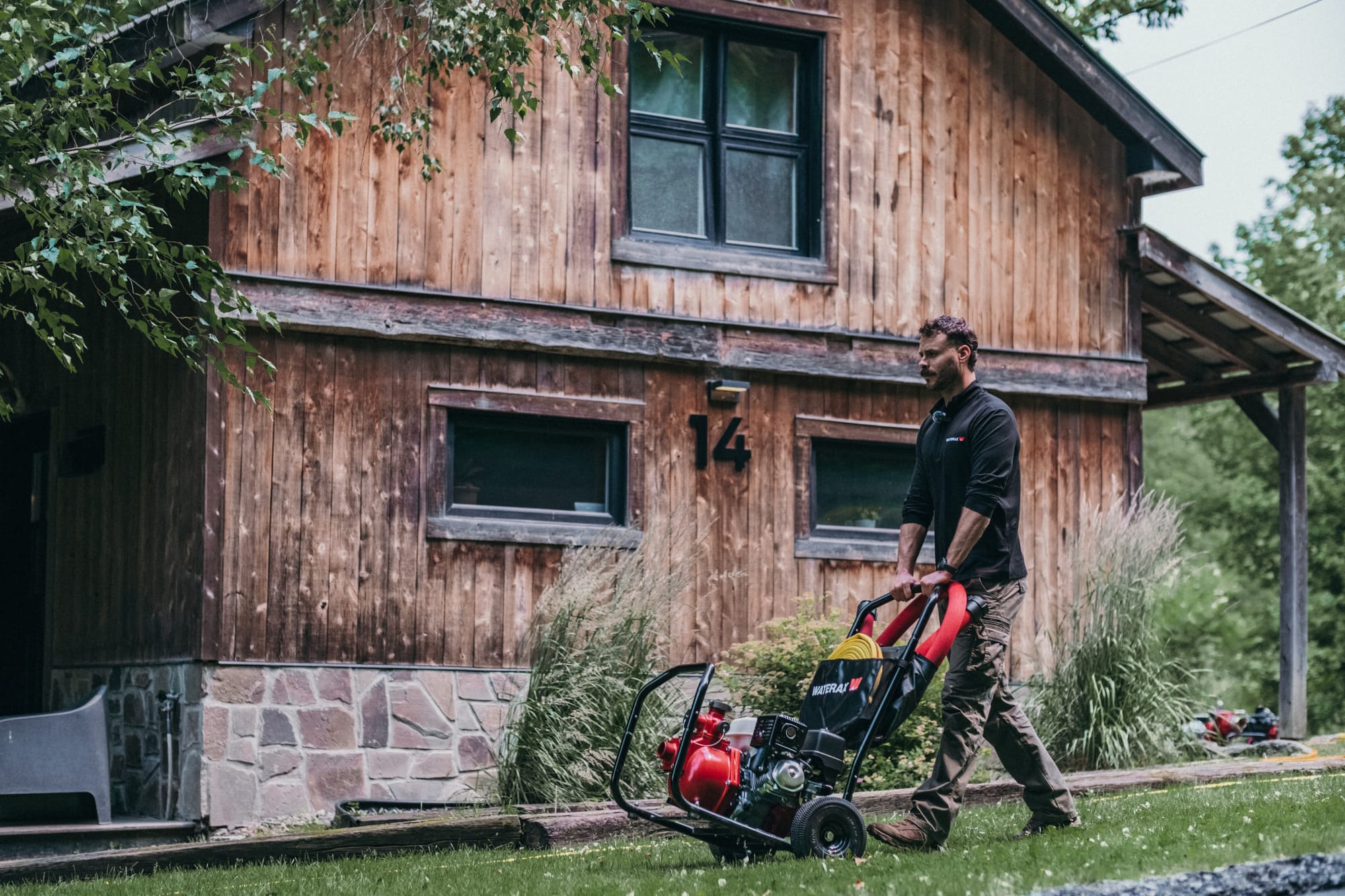
Every property presents different water-handling challenges, and there is no single pump for every scenario. A lakeside cabin with water nearby needs a very different system than a rural property protecting several structures across long hose lays. Water availability, terrain, elevation, required flow and pressure, hose distance and the number of structures all shape the design.
At a recent field demonstration, three portable pumping platforms were run side by side. The MINI-MARK® supplied sprinklers around a smaller structure where the water source was close at hand. The VERSAX® Cart System ran as a mobile, self-contained package that could be repositioned as conditions changed. The B2X-23PC handled the largest layout, feeding a 300-foot (91 m) 1½-inch trunk line to sixteen sprinklers across two cabins.
All three moved water. What separated them was the job in front of them: the best pump is the one that matches the water source, the system requirements and the application, not the one with the highest numbers on paper.
Preparation doesn't end with fire season
No portable pump, sprinkler system or single mitigation measure can guarantee that a structure survives a wildfire. But defensible space, a reliable water supply, suitable pumping equipment and a properly planned sprinkler layout each contribute to a more comprehensive approach to structure protection, and all four are easier to put in place now than in July.
The best time to work out how water will move during a wildfire is long before anyone needs it to.
A note on safety
Structure protection measures are never a substitute for evacuation. Residents should always follow evacuation orders and the direction of local fire and emergencymanagement officials.
Source note
Leger online survey of 1,538 Canadians aged 18+, conducted September 4–7, 2026. Results were weighted by age, gender, mother tongue, region, education and presence of children in the household to ensure a representative sample of the Canadian population. For comparison purposes, a probability sample of n=1,538 yields a margin of error no greater than ±2.5% (19 times out of 20).