
Five Things That Should Happen Before You Spec a Pump on Your Next Brush Truck
Scroll DownPump selection is usually the last decision in the apparatus design process. That's backwards.
Here's a conversation that happens more than it should. A department has already committed to a chassis. The body builder has been selected. Tank size is locked. The skid layout is roughed in. Then someone asks: what pump are we putting on this?
At that point, half the decisions that actually affect pump performance — payload, mounting position, plumbing runs, priming requirements — are already made. The pump gets spec'd around the constraints rather than the constraints being designed around the pump. It works, mostly. But it's not the right sequence.
Wildland apparatus decisions are more consequential than they used to be. Departments that ran one brush truck as a mutual aid resource are now building genuine wildland programs, driven by fire seasons that keep getting longer and a WUI footprint that keeps expanding. More apparatus, higher utilization, more varied terrain, and crews that in many cases are less mechanically experienced than the people who ran the previous generation of equipment. The pump matters more in that environment than it did when it was a secondary resource sitting in a bay most of the year.
These five things won't slow down your spec process. They'll focus it.
1 - Know your primary mission before you look at a single spec sheet
High pressure is not the same as high performance. A pump that's right for sustained direct attack over long hose lays and significant elevation changes is a different animal than one built for a WUI vehicle that needs to fill tanks from a pond, run a structure line, and maybe help knock down a roadside brush fire on the same shift.
Type 6 brush truck work demands consistent pressure over distance. The benchmark for this segment — four-stage centrifugal pumps delivering 440–470 PSI maximum — exists because that's what the mission requires. If your department operates under federal specifications or works alongside federal resources, the USFS Type 6 certification (Model 643P and 643U) is worth understanding before you start comparing pump data sheets. It's not just a federal procurement requirement — it's a performance and durability validation that tells you the pump has been tested against real operational standards, not just a lab bench.
WUI and dual-mission apparatus are a different conversation. Here you want volume as much as pressure. A two-stage mid-range pump that delivers up to 300 US gal/min free flow can handle tank filling, water transfer, and active suppression without the cost and payload premium of a high-pressure four-stage unit. For departments building their first dedicated wildland apparatus on a budget, that versatility often makes more operational sense than chasing maximum PSI.
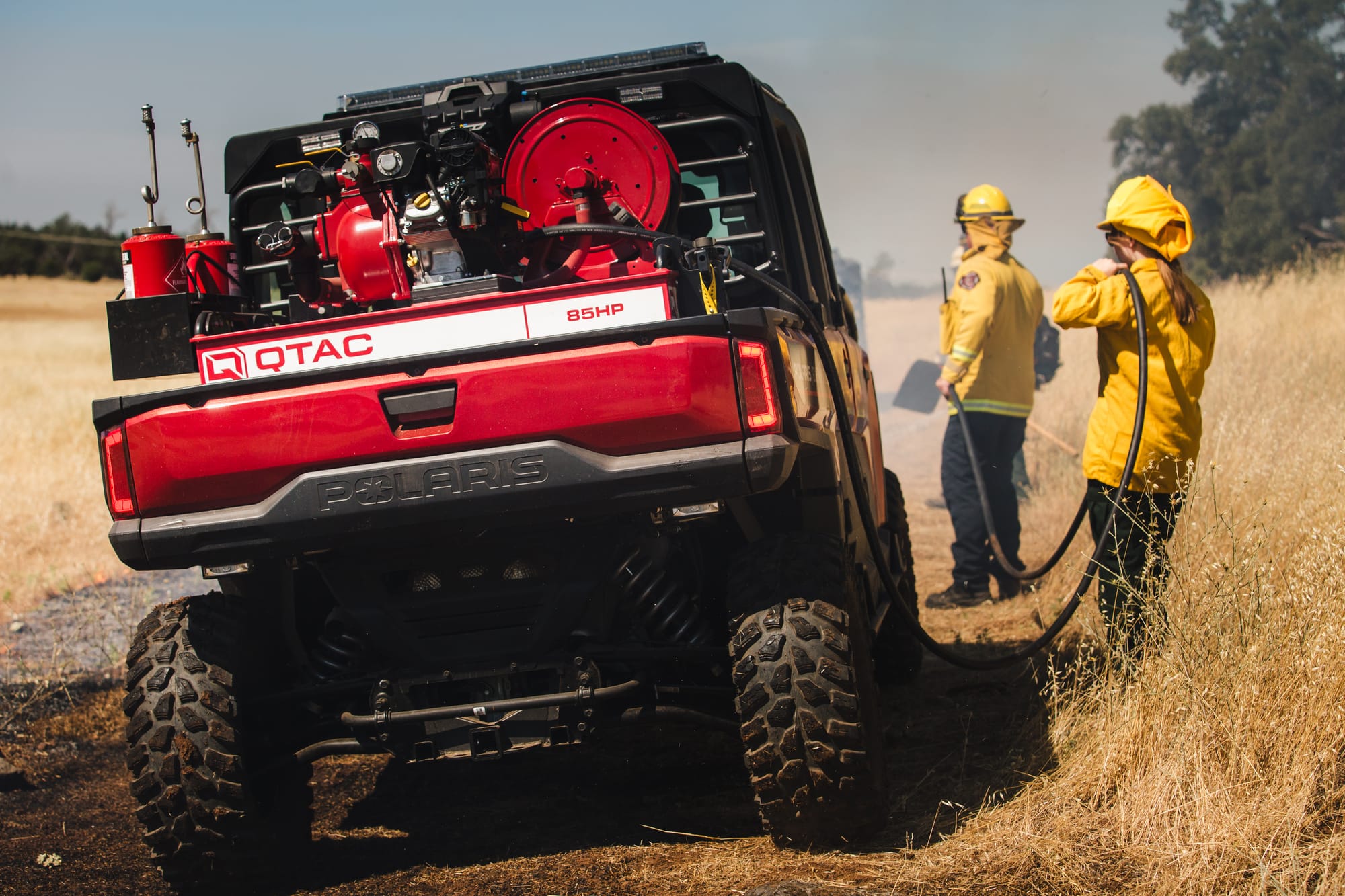
Type 7 and UTV builds are tighter still — payload constraints push toward compact configurations, and the gap between what compact pumps used to deliver and what they deliver now has closed considerably. Current compact four-stage vehicle-mount pumps can hit 310 PSI and 118 US gal/min free flow from a footprint sized for these builds, using pump end technology that didn't exist in compact configurations five years ago.
One more thing on UTVs: the loose portable pump carried on the apparatus has become standard practice in a lot of jurisdictions, and for good reason. When terrain takes the crew beyond where the skid can draft, a lightweight high-pressure portable gives you both a transfer capability to refill the tank and a secondary suppression tool. It's not a backup — it's part of the system.
2 - Look at your existing fleet before deciding what to carry forward
A lot of departments expanding their wildland capability are doing it on aging apparatus. That brush truck that's been in service for twelve years might have a perfectly good chassis left in it. The question is what's living on the back of it.
Pump systems on older wildland apparatus tend to age in predictable ways. Mechanical throttle systems wear and lose precision. Aluminum impellers corrode — slowly, then all at once. If you've ever had a mechanic tell you that the pump end service is going to take longer than expected because the impellers are seized, you know the problem. It's a consequence of galvanic corrosion in high-mineral or brackish water environments, which is exactly the water most wildland crews are drafting from. It's not a maintenance failure. It's what aluminum does in that environment over time.
Analog control interfaces, on the other hand, are more of a training problem than a mechanical one. They work fine for experienced operators who know what a healthy engine sounds and feels like. For newer crew members, they leave a lot of diagnostic information on the table — problems that could be caught early instead get discovered in the field.
When you're replacing a chassis, the pump question is worth asking directly: is this pump worth carrying forward, or am I inheriting ten years of deferred maintenance in a component that will be expensive to replace once the new apparatus is in service? Sometimes the answer is carry it forward. Sometimes it isn't. But the time to figure that out is during the spec process, not six months later.
Some pumps like the STRIKER-4 and the MARK-3® high-pressure pump are made with composite pump ends with corrosion-resistant impellers eliminate the seizure problem entirely. Digital interfaces with continuous monitoring catch the temperature and pressure anomalies that analog gauges don't surface until it's too late. Neither of these was standard equipment on apparatus built a decade ago.
3 - Make the fuel decision at the fleet level, not the apparatus level
Diesel standardization used to be a compromise. Diesel pump options didn't match their gasoline counterparts on performance, so departments that wanted diesel uniformity had to accept a gap somewhere. That's changed.
Current diesel platforms — Kubota D902 at 24.8 HP, Yanmar L100 at 9.3 HP — deliver performance that's equivalent to comparable gasoline configurations across the full range of apparatus types. A diesel four-stage high-pressure unit reaches 395 PSI and 106 US gal/min. A diesel mid-range hits 310 US gal/min free flow. Compact diesel options exist for Type 7 builds. You're not giving up pressure or volume to get diesel anymore.
The logistics argument is straightforward: one fuel type across a fleet means simpler storage, no contamination risk at the pump, and cleaner refueling at remote deployments where supply chains are not always reliable. The operational safety angle is less often discussed but worth naming — in hot, dry wildland environments, gasoline storage creates its own fire risk. Diesel's lower volatility is a practical consideration in exactly the terrain where these apparatus operate.
Make this decision before the pump spec, not after. Retrofitting a diesel pump onto an apparatus designed around gasoline, or the reverse, creates installation problems that are avoidable if fuel type is locked in early.
4 - Spec the operator interface for the crew you actually have
The crew that ran your brush truck ten years ago was probably different from the crew running it now. More diverse, often less time behind a mechanical pump, managing higher turnover in some departments, and in many cases splitting time between wildland response and other assignments that keep them away from the apparatus for months at a stretch.
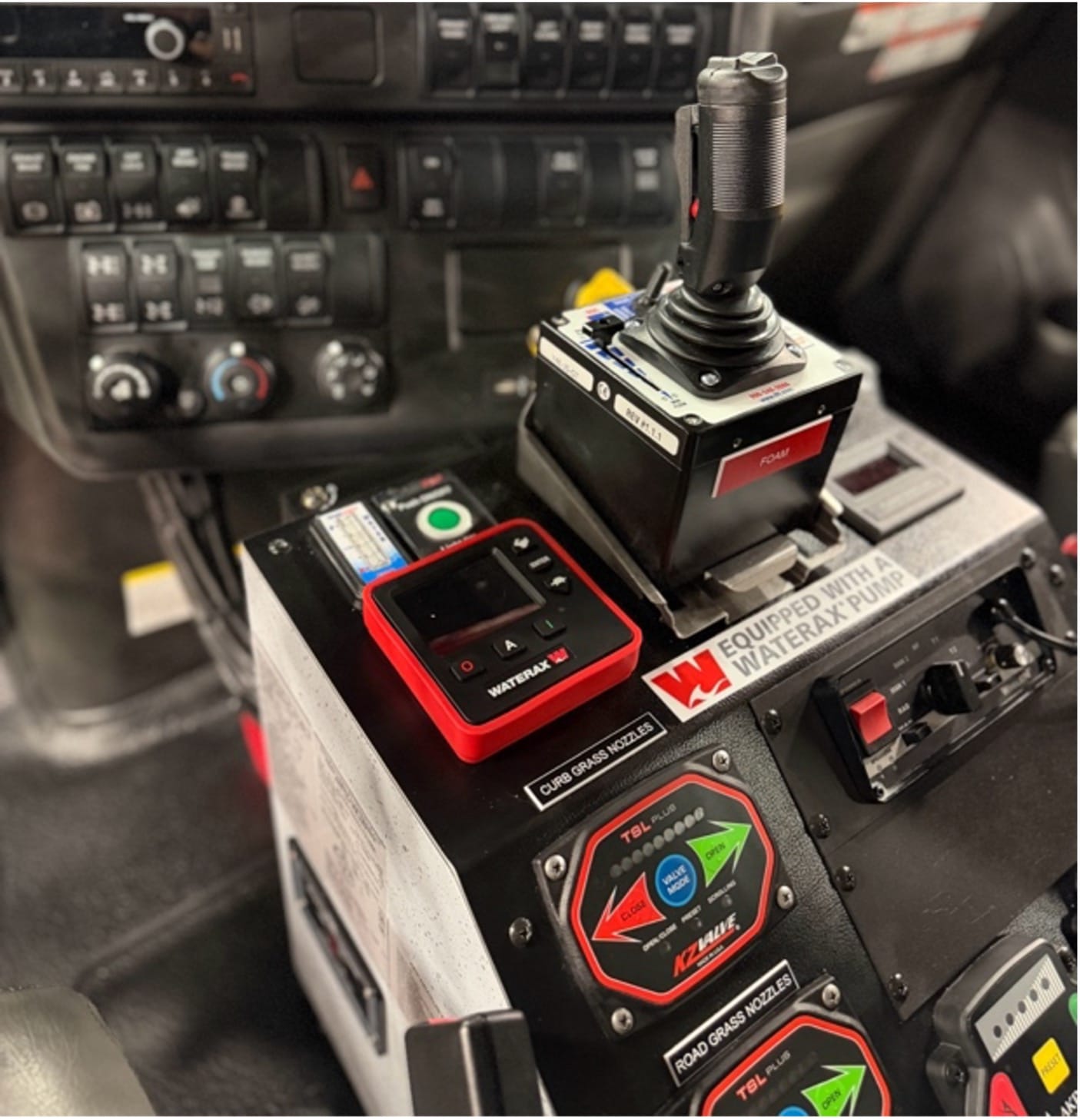
A mechanical pump interface — throttle cable, analog gauge, manual choke — rewards familiarity. For operators who run the pump regularly and have built their diagnostic instincts over seasons, it's fine. For everyone else, it creates gaps. Problems that an experienced operator would catch from sound or feel don't get caught until they show up as a stopped pump on the fireline.
Digital control panels change this. Start/stop, throttle control, continuous engine monitoring, and protection functions on a color display give the operator real information in real time. EFI integration means the panel talks directly to the engine ECU — precise throttle control without a separate mechanical actuator, which simplifies the installation and removes a failure point. A remote panel option lets you run dual-station control for pump-and-roll operations without the complexity of a parallel installation.
What departments report after making the switch is faster crew onboarding and fewer interruptions in the field. That's the practical payoff. When the pump tells you what it's doing rather than making you infer it, the gap between a third-season operator and a first-season operator gets meaningfully smaller.
5 - Get a skid builder in the room before the spec is finalized
The pump doesn't exist in isolation. It exists inside a skid package that involves plumbing, electrical integration, mounting hardware, chassis payload management, and water system design. These things interact. A pump that's straightforward to install on one chassis configuration can be a problem on another. Plumbing runs that work in one body layout don't work in a different one. Priming requirements vary by pump and by water source.
Departments that select the pump first and then find a builder to work around it sometimes spend time and money undoing decisions that could have been avoided. Bringing a skid builder in before the pump is locked gives you access to someone who has built these rigs before and knows where the integration issues live.
Good skid builders know the pump platforms they work with well — how they install, how they perform in the field configurations departments actually run, and where the real tradeoffs are between options at a given price point. When departments come to pump manufacturers directly for guidance, the answer is almost always: talk to a builder in your region first. That's where the apparatus design expertise lives.
A few specific questions worth putting to a builder before the spec closes: How does this pump affect what else can go on the apparatus given the chassis payload? What are the priming requirements for the water sources this apparatus will primarily use? Does a loose portable pump on the apparatus make sense as a companion piece? How does the pump's service schedule align with what the department's maintenance infrastructure can actually support?
These conversations go faster and produce better outcomes before the chassis is ordered than after.
None of these steps add time to the process. They move certain conversations earlier — where they're easier, cheaper, and more useful. Wildland apparatus is expensive and it's being asked to do more than it used to. Getting the pump decision right is part of getting the apparatus right.
WATERAX Vehicle-Mount Pump Lineup — Quick Reference
- BB-4® Series: Four-stage, up to 470 PSI — Type 6 brush trucks, direct attack. USFS Type 6 certified (BB-4-D902, BB-4-23V). Gas and diesel.
- B2X™ Series: Two-stage, up to 300 GPM free flow — WUI, dual-line attack, Type 5–7. Gas and diesel.
- STRIKER™ Series: Compact four-stage, up to 310 PSI — Type 7 and lightweight brush trucks. Gas (Honda GX390) and diesel (Yanmar L100).
- VERSAX® Series: Twin-impeller — multipurpose vehicles, tank fill, light-duty builds.
- DCP200 Digital Control Panel: Available for Honda IGX800 EFI, Kubota D902, and Yanmar L100 engines.
More information: waterax.com/en/vehicle-mount-pump-solutions
OEM inquiries: [email protected]